The Hidden Cost of a Bad Leadership Hire (And How to Price the Risk)
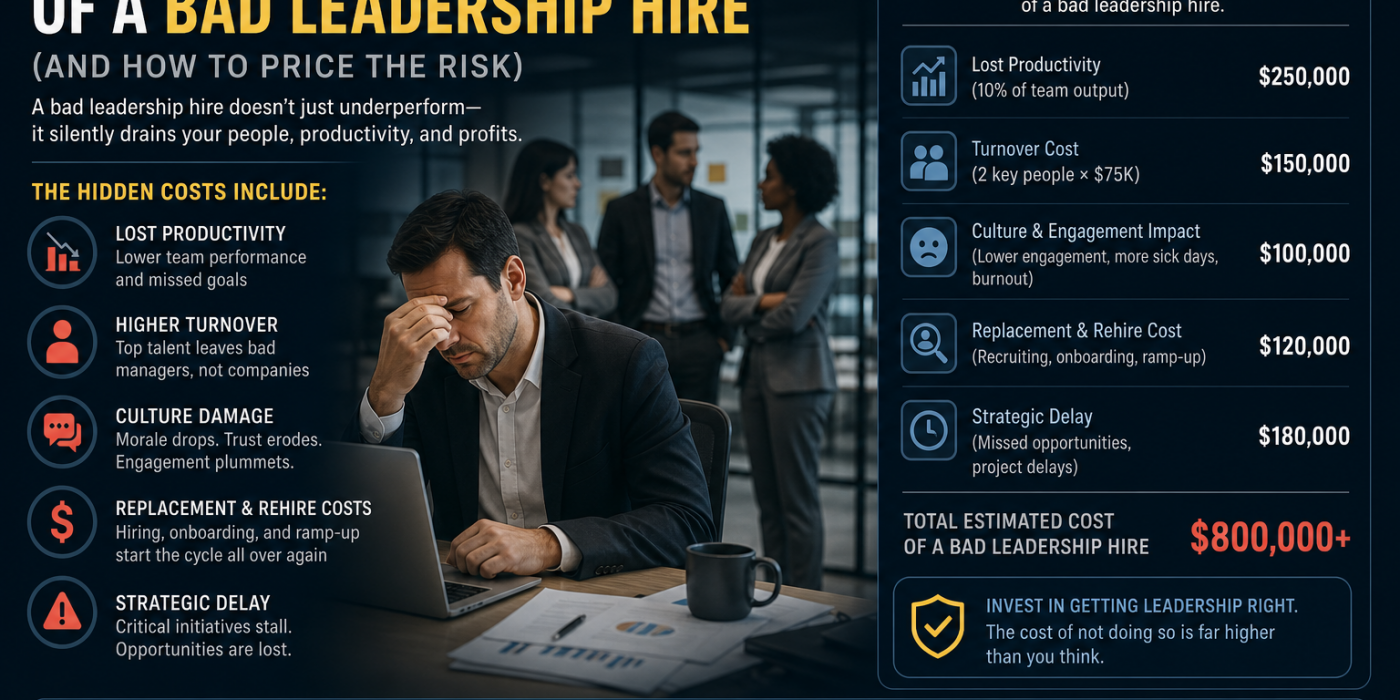
Ask five different sources what a bad senior hire costs, and you’ll get five different multiples of salary. A 2024 LinkedIn-cited study puts the figure at roughly three times annual salary once you count recruitment, onboarding, lost productivity, and the hit to team morale. Research cited via Gartner and Harvard Business Review puts the cumulative cost of a failed executive hire as high as 10 to 15 times annual salary once severance, strategic derailment, and team turnover are added in.
That’s not sloppy research. That’s the range you should expect when nobody agrees on what to count, and it’s exactly why most organizations never price this risk consistently. For a director or VP earning $220,000 in total compensation, that range runs from roughly $660,000 on the conservative end to $2.2 million to $3.3 million on the high end, depending entirely on how long the mistake runs and what gets swept up in the cleanup.
The number depends on one thing: how long it takes to admit the mistake
That’s the variable doing most of the work in the multiplier. Research from the University of South Carolina’s Center for Executive Succession found that poor decisions made by an underperforming leader continue to affect an organization for 24 to 36 months, even after that leader is gone. The bad hire might only be in the seat for six to twelve months before someone finally acts. The damage they did keeps compounding for two to three years past that.
This is the part most cost-of-bad-hire conversations skip. The salary, the severance, the redone search: those are visible, bounded, and relatively easy to estimate. The 24 to 36 months of decisions made on bad information, relationships damaged, and momentum lost are not. They’re also usually the larger number, which is exactly why the low-end multiplier (3x) and the high-end multiplier (10 to 15x) can both be technically correct. They’re measuring different lengths of denial.
What’s accumulating while everyone hopes it gets better
None of this shows up on a balance sheet, but the pattern is consistent. High-performing teams start to lose trust in leadership’s direction. Key talent quietly disengages or starts interviewing elsewhere. The organization shifts into a “play it safe” posture instead of moving forward on the initiatives that role was hired to drive. None of that requires the bad hire to do anything dramatic. It just requires them to stay long enough for good people to notice nothing is being done about it.
David Turetsky, Founder and CEO of HR Data Labs, sees the pattern show up the same way across very different clients. “The mistake everyone focuses on is the hiring decision itself,” he says. “The more expensive mistake is usually what happens in the six months after everyone privately knows it’s not working, and leadership keeps hoping the next quarter looks different. That gap between knowing and acting is where the real cost lives.”
Pricing the risk before it becomes a write-off
Most of what makes a bad hire expensive is preventable, not in the hiring decision itself (no process catches every mismatch) but in how fast the organization responds once the signs are there. A few things change that math:
- Set a hard, dated checkpoint, not a vague one. “We’ll see how it goes” has no expiration date. A specific 90-day and 180-day review, with defined evidence of what success looks like by each point, forces a decision instead of a drift.
- Separate the sunk cost from the decision. The search fee and the months already invested are gone either way. Treating them as a reason to wait longer only grows the 24-to-36-month tail, it doesn’t recover anything already spent.
- Build the off-ramp before you need it. Know who could cover the function on an interim basis, and what that costs, before a senior hire starts. Deciding this while the situation is already deteriorating guarantees the slower, more expensive version of every option.
- Track what happens after the seat is filled, not just whether it got filled. Most organizations measure a search’s success at the offer-accept stage and never look again. The 24-to-36-month tail is invisible precisely because nobody’s still watching by the time it shows up.
None of this prevents every bad hire. It shortens the distance between “this isn’t working” and acting on it, which is the single biggest lever on which end of the cost range an organization lands on.
The cost was never just the salary
A bad hire’s salary is the smallest, most visible number in this entire equation. The real cost is measured in quarters, not in a single line item: in decisions made on bad information, in good people who quietly start looking elsewhere, in momentum that takes years to rebuild even after the org chart is fixed. Organizations that price that timeline honestly tend to act faster. The ones that don’t are the ones still explaining, three years later, why that one hire set the team back so far.Trying to figure out whether a leadership hire is working, or what it’s costing you to wait and see? Contact HR Data Labs for a cons
Leave a Reply