Your Sales Comp Plan Is Rewarding the Wrong Behavior, Here’s How to Tell
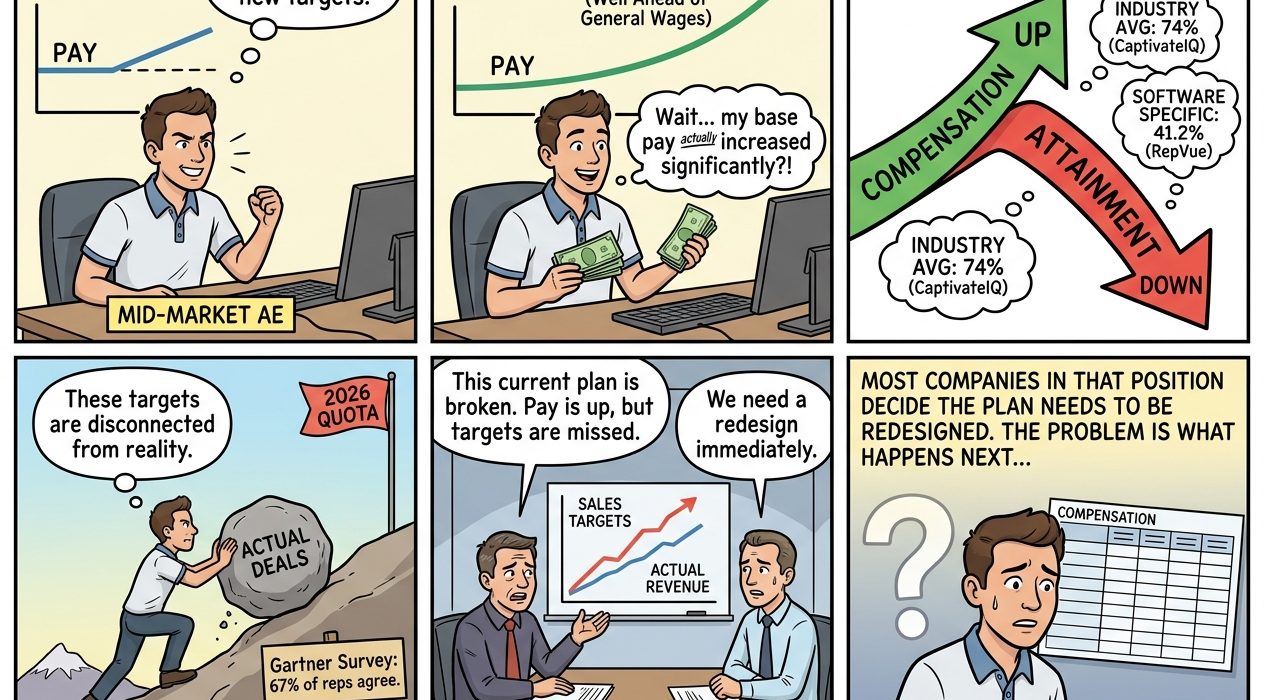
Something counterintuitive happened in sales compensation between 2024 and 2026. Pay went up. Mid-market AE compensation rose roughly 6 to 9% over that period, well ahead of general wage growth, according to 2026 benchmark data. Attainment went in the other direction. CaptivateIQ’s 2025 benchmarks put industry-wide average attainment at 74% of quota, and in software specifically, RepVue data shows only 41.2% of reps reach full quota. A Gartner peer survey found that 67% of sales professionals believe their own leadership’s targets are disconnected from the reality reps are actually selling into.
Pay climbed. Attainment fell. Most companies in that position do the right thing and decide the plan needs to be redesigned. The problem is what happens next.
Most redesigns fail because they only fix half the problem
A compensation plan redesign is the correct instinct when attainment slides. Where most of those redesigns go wrong is in scope. Internal redesigns tend to touch the mechanics that are easiest to see and easiest to change: the split, the accelerator curve, a new SPIF layered on top. What they almost never touch is the quota methodology underneath the plan, the actual conversion data, win rates, and pipeline quality that the targets were supposed to be built on in the first place.
That’s a problem, because 2026 data on quota and pipeline math shows the targets themselves are frequently built on generic industry benchmarks rather than the org’s own funnel data. If a redesign changes the incentive mechanics but leaves that same flawed quota methodology in place, the new plan inherits the same broken inputs the old one had. Six months later, the plan looks different on paper and produces the same miss rate, because half the actual problem was never in scope.
This is why a real redesign must treat quota methodology as part of the engagement, not a separate workstream to deal with later. The mechanics and targets feeding them are one system. Fixing one while leaving the other untouched isn’t a smaller, more efficient redesign. It’s an incomplete one.
What signals where the redesign needs to focus
A few patterns point at exactly where a redesign needs to spend its time:
- Discounting clusters at the end of the quarter. If a revenue-only quota structure is pushing reps to slash margin in the final week to close anything that moves, the incentive mechanics are rewarding speed over deal quality. That’s a design fix.
- Reps optimize one metric while ignoring the strategic priority. A plan built around a single number (new logos, for instance) will get exactly that, even when the business needs expansion revenue or multi-year commitments. That’s a design fix too.
- Attainment is uniformly low, including among historically strong performers. When the shortfall shows up everywhere, regardless of rep quality or territory, that points at the quota methodology, not the incentive structure. The targets were set on assumptions the pipeline can’t support.
- Commission disputes are common, and reps don’t trust their own statements. Industry data from 2026 puts commission disputes at roughly 22% of reps annually, with about 9% leaving a role specifically over payout errors. That’s almost always a mechanics problem: too many metrics, unclear weighting, logic reps can’t independently verify.
Most organizations have a combination of both. That’s exactly why a redesign scoped to “fix the plan” without examining the quota math underneath it usually disappoints, and why a redesign that only recalibrates targets without addressing genuinely broken incentive mechanics disappoints just as often.
Angela Bailey, Principal Consultant at HR Data Labs, sees this gap constantly in client engagements. “Companies will come to us wanting a new accelerator structure or a cleaner split,” she says. “Half the time, the real issue is sitting one layer down, in how the quotas were built in the first place. A redesign that only touches the part the client asked for leaves the actual problem in place. The plan that works is the one where we look at both pieces together, not just the part that’s easiest to point at.”
How to scope a redesign that holds
Run the current plan against a few different cuts of the team before deciding where to focus. If attainment varies wildly by territory or segment, that points at quota and territory design needing attention. If attainment is uniformly low across previously strong performers too, the targets are very likely underbuilt on real pipeline data, regardless of how clean the incentive mechanics already are.
Look for specific behavior, not just the missed number. Discount clustering, single-metric gaming, and deals structured to hit a threshold rather than serve the customer are mechanics problems a redesign needs to solve directly. A uniform shortfall without those behavioral fingerprints is more often a sign that the quota-setting process itself needs to be rebuilt alongside the plan.
And ask reps to walk through their own commission calculation without help. If they can’t, that’s a mechanics issue no quota recalibration will fix on its own.
A redesign that does the whole job, not half of it
Rebuilding a compensation plan is a real investment, in time, in disruption, in trust with the sales team while it’s underway. The redesigns that hold up a year later are the ones that treated the incentive structure and the quota methodology as a single system from the start, instead of fixing the visible half and hoping the rest sorts itself out. That’s the difference between a new plan that moves attainment and a new plan that just looks different on paper.
Wondering whether your sales comp plan needs a full redesign, not just a tweak? Contact HR Data Labs for a consultation.
Leave a Reply