Why Your Compensation Bands Are Already Out of Date
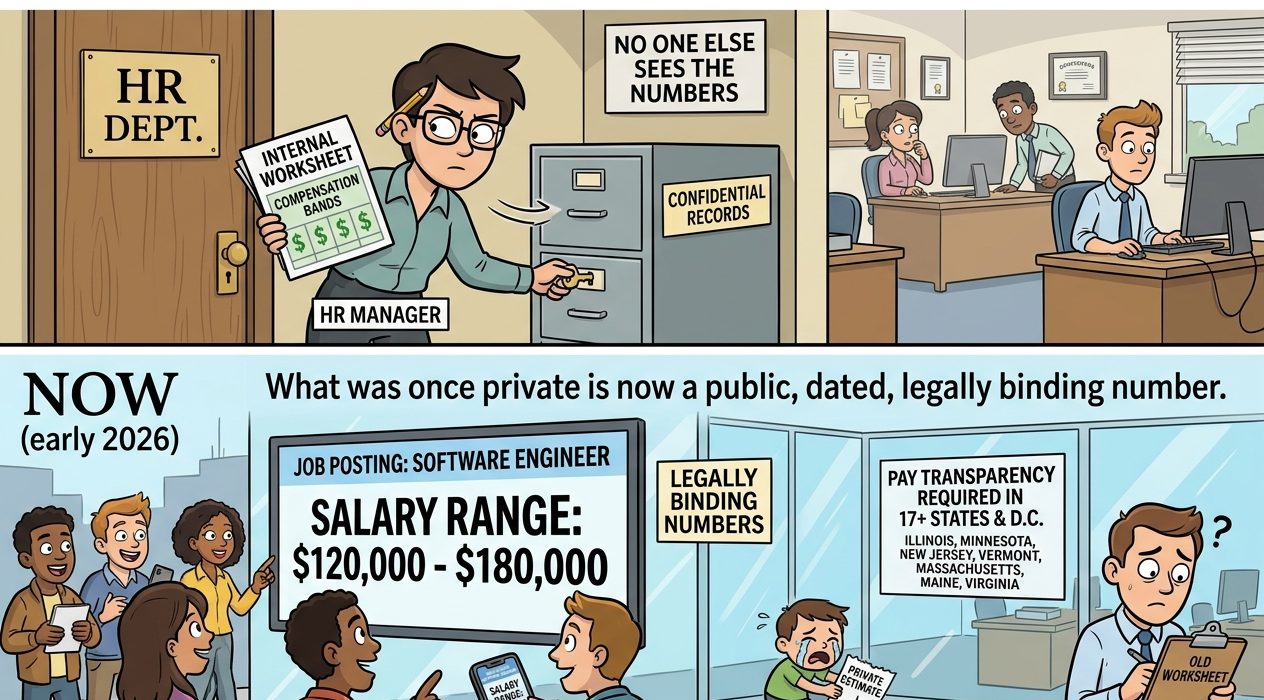
Compensation bands used to be internal worksheets. Outside HR and a small group of managers, no one saw the actual numbers. That has changed. As of early 2026, at least 17 states plus Washington, D.C. require employers to publish real salary ranges in job postings, and roughly half of those laws took effect or were substantially revised in the past 18 months: Illinois and Minnesota in January 2025, New Jersey in June 2025, Vermont in July 2025, Massachusetts in October 2025, and Maine and Virginia in 2026.
What was once a private estimate is now a public, dated, legally binding number. Yet many companies still treat it like the old worksheet.
Regulators are targeting the exact mistake most bands make
Anyone who built their bands more than a year ago should pay attention: the legal standard is tightening around the exact issue that makes bands go stale. California’s SB 642, effective January 2026, redefined “pay scale” to mean the actual good faith range an employer expects to pay, not a broad placeholder. Massachusetts and New Jersey have also moved from policy to active enforcement in 2026, auditing postings and issuing penalties for ranges that look more like guesses than defensible numbers.
A wide, vague band used to be a private hedge. Now it’s the kind of thing a regulator can flag directly from a public job posting. The mistake that was invisible when bands were internal is now sitting in plain text, with a timestamp, in front of exactly the people most likely to notice: candidates, current employees in the same role, and the state.
Bands go stale at different speeds, and the national average hides that
The headline numbers suggest compensation is cooling off. The Conference Board’s 40th annual Salary Increase Budget Survey puts the 2026 median salary increase at roughly 3.5%, in line with 2025. That’s a real number, but it’s a blended average sitting on top of enormous variation by function and skill. According to the Bureau of Labor Statistics data shows healthcare and social assistance wages grew 4.5% over the twelve months ending in June 2025, well ahead of that broad median.
A single company-wide review cycle applied evenly across every band will systematically under-correct the roles where the market is moving and waste effort re-confirming the roles that haven’t shifted at all. The band for a hot-skill function can be six to nine months behind market before the next scheduled review even comes around, while a slower-moving role gets revisited on the same calendar for no real reason.
That gap is exactly where IBEJesus Prince, Principal Consultant at HR Data Labs, sees companies get caught off guard.
“Most companies built their bands once, felt good about it, and moved on. Nobody’s asking whether the band is still accurate. They’re asking whether it’s been long enough since the last review to look at it again. Those are completely different questions, and the second one is the wrong one to be asking when a regulator or a candidate can see the actual number you posted.”
What keeps a band current
A band doesn’t go stale on a fixed schedule. It goes stale at the pace of its specific labor market, and the only way to catch that is to stop treating “review cadence” as one company-wide date on the calendar.
Review frequency should track how fast that specific market is moving, not a blanket annual date. A function with 4 to 5% wage growth needs a tighter review cycle than one tracking the broad 3.5% median.
The “good faith” legal standard is the actual test, not the calendar. If you couldn’t defend the posted range as accurate today, the date of the last review doesn’t matter. It’s already out of date.
The gap between what current employees earn and what the band says for new hires in the same role is worth watching closely. Pay transparency makes that gap visible to your own team the moment a new requisition posts, whether you’ve priced for that or not.
Light, ongoing monitoring beats a once-a-year overhaul. With several states amending their pay transparency requirements year over year, an annual cycle is already structured to fall behind the legal standard, not just the market.
None of this requires constant rebuilding. It requires treating the band as a number that must stay true, not a project that gets marked done.
Out of date isn’t a someday problem anymore
A comp band used to drift quietly. Nobody outside a small group noticed until a candidate pushed back in a negotiation or a long-tenured employee compared notes. Pay transparency removed the quiet part. The drift is now visible in real time, to regulators, to candidates, and to the people already on payroll, the moment it’s posted. Companies that treat their bands as a living number, not a finished deliverable, are the ones who won’t get caught explaining a range they can no longer defend.
Not sure whether your comp bands would hold up to today’s posting requirements? Contact HR Data Labs for a consultation.
Leave a Reply