Why Most Executive Searches Fail Before the Job Description Is Even Written
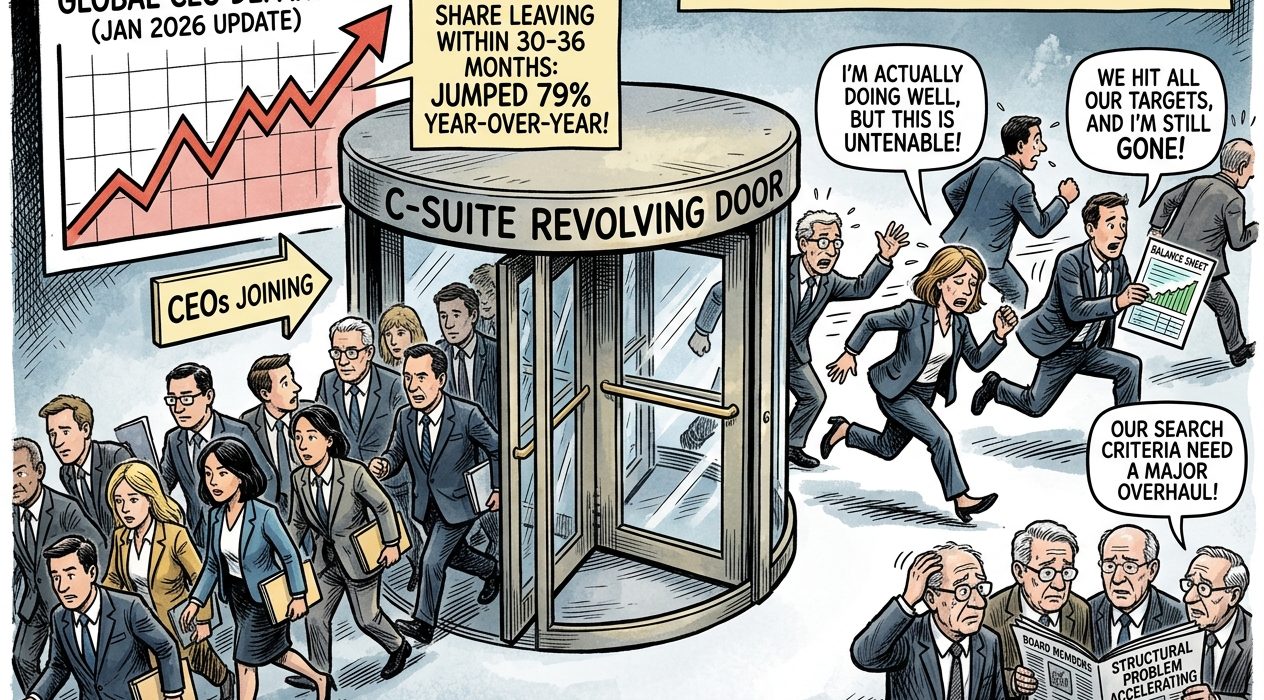
The data on C-suite turnover keeps getting worse, not better. The latest read on global CEO departures, published in January 2026, found that the share of CEOs leaving within just 30 to 36 months of taking the role jumped 79% year-over-year. That’s not a slow drift. That’s a structural problem accelerating in real time.
And here’s the detail that should worry every board and CEO running a search right now: it isn’t just underperformers walking out the door.
The instability isn’t about competence. That’s the tell.
A November 2025 report from The Conference Board, Egon Zehnder, ESGAUGE, and Semler Brossy, based on SEC filings across the Russell 3000 and S&P 500 through October 2025, found that CEO turnover rose even among top-performing companies. Among the strongest performers in the S&P 500, turnover jumped from 7% to 12% in a single year, closing the gap with the lowest-performing quartile.
Read that carefully. If executive failure were primarily about skill or output, you’d expect instability to concentrate among the weak performers. It isn’t. Strong performers are losing their CEOs at nearly the same rate as struggling ones. Russell Reynolds’ Global CEO Turnover Index backs this up at the macro level: average global CEO tenure has fallen every year since 2021, from 8.3 years down to 7.1 years in 2025.
Something other than competence is driving people out of the chair faster than ever. The most consistent explanation in the research, and the one that holds up under scrutiny, is that the organization and the executive were never working from the same definition of the job in the first place.
The cost of getting this wrong just got a number attached to it
SHRM’s 2025 Benchmarking Report, fielded in early 2025 across more than 2,300 SHRM members, with oversampling at the VP-and-above level, put a hard figure on this: the average cost to fill an executive role now runs $35,879, nearly seven times the $5,475 average cost-per-hire for non-executive roles. That’s before a single day of the executive’s salary is paid, before onboarding, before the cost of finding out six months later that the hire isn’t working.
And here’s the part that should alarm a board: the same SHRM research found that only 20% of organizations formally track quality of hire. Translation? Four out of five companies have no structured way to know whether their last executive hire succeeded, which means they have no structured way to fix what went wrong before the next search. The mistake doesn’t just happen once. It gets repeated, quietly, because nobody built a feedback loop.
The failure rarely starts in the interview room
When boards and CEOs autopsy a failed executive hire, the instinct is to blame the candidate: wrong fit, wrong skills, wrong read on culture. But look at how these breakdowns unfold, and a different pattern shows up consistently in recent search-industry analysis. The breakdown usually starts weeks before the first interview, when the hiring committee never nailed down a shared definition of what the role needed to accomplish.
Three stakeholders, three different answers to “what does success look like in this role.” A CEO optimizing for speed. A board optimizing risk. A department head optimizing for a skill set the other two haven’t even considered. Each perspective is reasonable in isolation. Together, unresolved, they guarantee that whoever gets hired inherits a conflict they didn’t create and can’t see coming.
This is why “must-have” qualifications shift midway through a search. It’s why a candidate who looked perfect in week two suddenly seems wrong in week six. It’s why some searches drag on for months while strong candidates take competing offers elsewhere. The search isn’t failing. The brief was never finished.
“Most executive searches don’t fail in the interview room,” says David Turetsky, Founder and CEO of HR Data Labs. “They fail in the weeks before, when nobody in the room has agreed on what success looks like. By the time we’re sourcing candidates, that disagreement is already baked into the search and it always surfaces eventually, usually at the worst possible time.”
The broader hiring market backs this up with fresh numbers. Recent labor-market data tracking 2025 hiring outcomes found that the average time from job posting to completed hire jumped 65% over three years, from 29 days to 48, and that roughly a third of open roles never got filled at all. The same analysis found a clear pattern among the organizations that still converted efficiently: they defined the role tightly before the search ever opened. Loose briefs didn’t just produce worse hires. They produced slower, more expensive, more frequently abandoned searches.
What a properly scoped search requires
Firms that get this right share one habit: they treat the intake conversation as the most important part of the engagement, not a formality before the “real work” of sourcing begins. Before a search opens, four questions need clear, agreed-upon answers from every decision-maker in the room:
- What does this person need to be true of the business in 12 months for this hire to be a success? Not a list of traits, an outcome.
- Where do we already disagree, and who has final say when we still disagree later? Surfacing conflict early is cheaper than discovering it in month four.
- What’s non-negotiable versus what’s a preference dressed up as a requirement? Most specifications that “can’t find anyone” are specifications that don’t exist in the market at the price point being offered.
- What does this role need to evolve into, not just fill? Hiring for today’s org chart guarantees a search for tomorrows.
None of this is complicated. It’s also routinely skipped, because alignment meetings feel like overhead when there’s pressure to fill a seat fast. That pressure is exactly what’s showing up in the turnover data and exactly what a disciplined intake process is designed to absorb.
The real differentiator isn’t sourcing. It’s the brief.
Every search firm has access to LinkedIn, referral networks, and a database of “available” executives. That’s table stakes, not a differentiator. What separates a search that produces a multi-year hire from one that produces another data point in next year’s turnover index is almost always decided before a single resume gets reviewed; in the rigor, or lack of it, applied to defining the role itself.
If your last few executive hires haven’t worked out, the post-mortem probably shouldn’t start with the candidate. It should start with the brief.Considering an executive search, or trying to figure out why your last one didn’t stick? Contact HR Data Labs for a consultation.
Leave a Reply