The Real Cost of a Vacant Leadership Seat: Why Speed-to-Hire Should Be Priced Like Risk
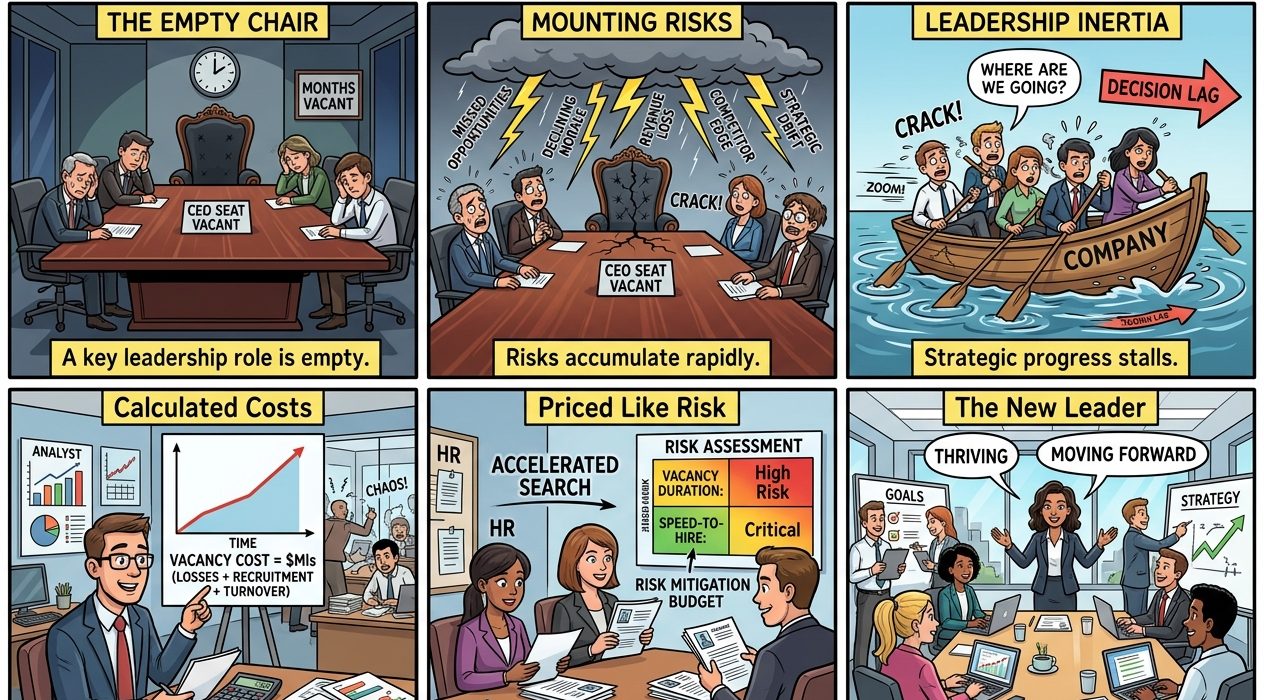
DDI’s Global Leadership Forecast 2025, drawing on responses from 2,185 HR professionals and 10,796 leaders across more than 50 countries, found that 77% of CHROs lack confidence in their bench strength for critical roles. Only 20% of HR leaders say they have a successor ready to step into a critical role today. Just 49% of those roles could be filled internally on short notice, even though 75% of organizations say they prioritize internal promotion over external hiring.
Read those numbers together and the gap is the story: most organizations want to promote from within, and most organizations can’t, because the bench underneath their critical roles isn’t ready. That gap is a cost. It rarely gets priced as one.
This isn’t a CEO problem. It’s a director and VP problem.
CEO succession gets the board attention, the headlines, and the consulting decks. But CEO seats are rare and visible, and most organizations at least attempt to plan for them. The layer where leadership transitions happen constantly, where strategy gets translated into execution, sits below that: director and VP. That’s also where research consistently shows readiness is least validated and risk is most concentrated, precisely because it doesn’t get the same structured attention CEO succession does.
A strong bench at the top of the org chart means little if the next layer down is thin. Strategy doesn’t get executed by the CEO. It gets executed by the directors and VPs translating it into decisions, budgets, and teams, day after day. When that layer has a vacancy, the disruption isn’t symbolic. It’s operational, and it happens far more often than any single CEO transition.
The bench you’re counting on is also a flight risk
Here’s what makes the gap worse: the leaders you’d be counting on to fill that bench are themselves under strain. DDI’s research found that 71% of leaders report increased stress, and among that group, 40% say they’ve considered leaving leadership roles entirely to protect their wellbeing. The “ready-in-two-years” successor on a 9-box grid isn’t a fixed asset. They’re a person currently deciding whether leadership is worth the cost, and a meaningful share of them are leaning toward no.
That means succession plans built on assumed future readiness are often built on sand. The pipeline isn’t just thin. It’s actively eroding while nobody’s watching the gauge.
What an unplanned vacancy costs while it sits open
Industry benchmarking on VP-level hiring puts the fully loaded cost to fill that seat (search fees, executive assessments, internal interview time) in the range of $30,000 to $50,000, before a day of the new hire’s salary is paid. That number alone makes a VP vacancy expensive. But it understates the real exposure, because most cost models only ever account for one open seat at a time.
In practice, organizations of any real size don’t have one director or VP vacancy. They have several, running concurrently, at different stages of the search process, each one quietly degrading execution in its own function while it sits open. A board that carefully models the cost of a single CEO transition almost never models the cumulative cost of the five or six director and VP seats turning over in the same eighteen months. Those seats are individually less visible and collectively far more expensive, because nobody adds them up.
That’s a pattern Desiree Goldey, Senior Consultant at HR Data Labs, sees constantly in client engagements that start out scoped as “just one VP search.” “Companies will plan carefully, sometimes, for the CEO seat,” she says. “Almost nobody plans for the five director and VP seats turning over in the same year and a half, even though those are the seats running the business day to day. Nobody’s adding up what all of them sitting open at once is really costing.”
Why speed-to-hire still gets treated as a cost to cut, not a risk to price
Below the C-suite, the instinct to compress a search and minimize the fee is even stronger than it is at the top, because a director or VP vacancy feels more replaceable than a CEO vacancy. It usually isn’t. The function still needs direction. Decisions still need an owner. And a rushed search at this level produces the same kind of misalignment problems a rushed executive search does: a brief that was never fully agreed on, a hire who looks right on paper but isn’t aligned with what the role needed, and a second search within eighteen months.
The data on the other side of that risk is worth sitting with. DDI’s research found that organizations with strong leadership pipelines are 2.9 times more likely to be top financial performers and 3.5 times more likely to be highly regarded in their industry, compared to organizations with weak ones. Bench strength at the director and VP level isn’t a talent management nicety. It’s a measurable performance variable, and most organizations are running without it.
How to price vacancy risk below the C-suite
Before a critical director or VP seat opens (or as soon as it has), leadership should be able to answer:
- How many critical seats below the C-suite are open or likely to open in the next two quarters? Most organizations have never counted these across functions at the same time.
- What’s the combined cost of those seats sitting open, not just one at a time? A single vacancy looks manageable. Five concurrent ones, multiplied by months of delay, rarely are.
- Is there a real internal bench for this role, or a name on a spreadsheet? DDI’s 49% figure is the benchmark to beat: if fewer than half of your critical roles could be filled internally today, the gap is already there, whether or not a seat has opened yet.
- Is succession planning happening at the director and VP layer, or only at the top of the house? Most organizations concentrate succession effort where it’s most visible and least frequently needed.
None of this requires predicting exactly which seat opens next. It requires accepting that several will, most likely below the C-suite, and pricing that risk before it becomes a fire drill.
The fee was never the expensive part
A search fee is a number on an invoice. A vacancy, especially several of them running at once below the C-suite, is a number on the business: in decisions without an owner, in strategy that never gets translated into execution, in the eventual cost of redoing a rushed search that didn’t hold. Organizations that treat the fee as the cost to manage are optimizing the wrong side of the ledger. The ones that come out ahead are the ones that count the seats, not just the seat.
Trying to figure out what your next leadership vacancy would cost, or how to plan for one before it happens? Contact HR Data Labs for a consultation.
Leave a Reply